Nonfiction
Archive
Books read before March, 2026. I didn't write reviews of books at this time after reading them, so I'll only write ones for books that stuck with me in some way to put them here. Keep in mind that these reviews were written a while after I actually read the books.The Lavender Scare: The Cold War Persecution of Gays and Lesbians in the Federal Goverment | David K. Johnson
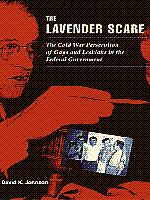
The Lavender Scare: The Cold War Persecution of Gays and Lesbians in the Federal Goverment | David K. Johnson
Rating: 4✶ | Date: 9 August, 2025
I read this book in August of 2025, so it’s been a while, meaning that I can’t give a highly detailed review and can only relay some of the feelings I remember feeling while reading this book months prior. I think it’s best to just give you some short bullet points regarding my thoughts:
- It was interesting to read how the Red Scare also affected homosexuals in a way, and how the two groups were viewed similarly;
- It was also interesting to read about how some stereotypes (if that’s the word for it) regarding homosexuals as dangers began to take shape in the larger social mindset;
- Johnson touched on how lesbians and gays experienced homophobia differently, due to their genders, which I feel is very important to talk about.
All in all, it was a good read. The information was new to me. But I did think that the writing was a little bit repetitive and boring at times.
April, 2026
Bluets | Maggie Nelson
Bluets | Maggie Nelson
Rating: 3✶ | Date: 9 April
Fav. Quote: “On my cv it says that I am currently working on a book about the color blue. I have been saying this for years without writing a word. It is, perhaps, my way of making my life feel “in progress” rather than a sleeve of ash falling off a lit cigarette."
Review:
This short little piece satisfied me in a way I hadn’t known I needed. I never thought about colour in such an interesting way — I never thought about personifying, falling in love with it, studying it.
Bluets isn’t really a narrative story for me, it’s a collection of thoughts and quotes. It’s a short piece that shows Nelson’s opinions about a wide range of topics — blue, love, lust. I’ve read The Red Parts, which I rated a little higher than this one, but the writing in both was great.
While reading this, I got lost in the words, I forgot them and let the feelings flow through me. This isn’t the author’s fault, of course, it’s just that I read these kinds of stories like that. English is my second language, so with works like these it’s difficult for me to follow and shape my own thoughts. That’s why this review is so short, even though I feel like a reader more familiar with such stories could write much more about it.
I guess I just want to say: Bluets was good, enjoyable, but perhaps not for me. It was nice to read about another person’s thoughts, though, and I feel like this book could be the perfect introduction to the topics it handles, specifically love and colors and the philosophy surrounding those things. I like works that quote other authors, since it introduces works I hadn’t heard about.
So, I recommend reading Bluets. It’s short, beautiful. Even if this isn’t really your kind of story — it might open some doors you hadn’t known about.
(p.s. — I also like the short moments of lust, the strange explicitly. I love an author with erotic thoughts they aren’t ashamed to share)
The Forbidden Garden of Leningrad: A True Story of Science and Sacrifice in a City under Siege | Simon Parkin
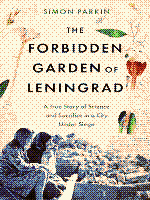
The Forbidden Garden of Leningrad: A True Story of Science and Sacrifice in a City under Siege | Simon Parkin
Rating: 3✶ | Date: 30 April
I honestly don’t have much to say about this one. Reviewing nonfiction is harder for me than reviewing fiction. I can’t just say change the story here, add this, remove this, because a nonfiction story doesn’t have the same potential of change like a fiction story does. Especially when it happened a while ago, when the story is already kind of over and close-ended. I am aware of all of the nuances of a nonfiction book. History deserves to be told, not every novel has to be a thrill.
The Forbidden Garden of Leningrad talks about the Institute of Plant Industry of St. Petersburg (formerly Leningrad). It centers on Nikolai Vavilov, who started the Institute, and his staff. Particularly how the Institute managed during Germany’s siege of Leningrad during the second world war.
A side part to the siege is Vavilov’s death, and his “conflict” with Trofim Lysenko. Both were scientists, but if you search up Lysenko you can see that he was more pseudoscientific. Stalin preferred him, and Vavilov — and the Institute by extension — suffered because of this. Vavilov started the Institute because he wanted to end famine in Russia by finding ways to breed plants that could survive in harsher climates and give great yields.
During the siege, Vavilov’s staff are enduring famine themselves. But they have so many things they could have eaten in the collection, and yet they didn’t. The main moral question Parkin asks is this: Is it better for the staff to refuse eating/distributing the seeds, some of which grew plants that could no longer be found, or should they ensure the survival of the collection, for further research, even if it means that they die from starvation?
The thing is, the book can be a little repetitive. Which is understandable — the siege lasted over 800 days, and there wasn’t much space for military development during the harsh winter of 1941 (from what I recall it was 1941, sorry if I’m remembering wrong!). I can’t fault Parkin for this, and I can’t just say the Leningrad siege was boring, let’s not write about it! Since that would be incredibly insensitive to the people who died because of the siege. And I don’t believe that the siege and the Institute were boring, but that was my feeling while reading Parkin’s book about it. I can fault Parkin for asking the same moral question verbatim multiple times, without adding anything to it any time. It was Parkin’s job to make the story pace well, it was his job to figure out how to tell the “boring” parts in an interesting way without repeating information constantly.
I guess what I want to say is this: the author of a nonfiction book can’t change the story, but they can choose how they represent it. Nonfiction books can still be written beautifully and they can be captivating while still showing the true story. Nonfiction books do not have to feel like school books.
June, 2026
The Ghost Map: The Story of London's Most Terrifying Epidemic—and How It Changed Science, Cities, and the Modern World | Steven Johnson
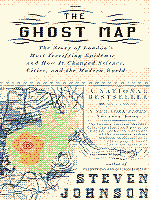
The Ghost Map: The Story of London's Most Terrifying Epidemic—and How It Changed Science, Cities, and the Modern World | Steven Johnson
Rating: 4.5✶ | Date: 1 June | Time: 5h 56m
Fav. Quote: “Miasma was so much less complicated. You didn’t need to build a consilient chain of argument to make the case for miasma. You just needed to point to the air and say: Do you smell that?”
This book kind of felt like a breath of fresh air for me. It’s been a while since I truly enjoyed a nonfiction book the whole way through.
The Ghost Map mainly talks about the 1854 outbreak of Cholera in London’s Broad Street (now known as Broadwick Street). At that time, people mainly believed that diseases like cholera were caused by polluted air, and this belief was often supported by the fact that these outbreaks were often started in places that were often populated by lower-class people.
It’s difficult to fully explain every topic this book talked about, since it touched on a wide array of topics that fit into each other to explain all of the elements that allowed Broad Street to be hit so hard by cholera. Johnson gives insights about urbanisation, population density, the miasma theory of the time (which believes that diseases like cholera are caused by bad air vapours), and how the waterborne theory was developed, giving the people a better understanding of cholera and how to avoid its recurrence.
I liked how London at the time was portrayed as a sort of monster, a city with its own will. I’m currently in the semester of school that teaches us about micro-organisms, so it was interesting to see how the things we’re currently taught are different from the beliefs of the Victorian era.
It’s admirable how Johnson managed to be very educational without making The Ghost Map feel like a school text book about biology and sociology. In a nonfiction book like this, it could be very easy to infodump, but Johnson found a great balance between giving information and recalling relevant events.
I would have given it 5 stars, but the last chapter kind of brought the thing down for me a bit. The last chapter talked about urbanisation and megacities. It was interesting, but a tad too long and repetitive. Especially because the opinions and predictions Johnson relays aren’t very unique. I think many people know that living in a larger city might also make you more vulnerable during terrorist attacks, war, or during a disease outbreak. I also think most people know that there are pros to living in urban areas, but there are also cons to it. I don’t think the chapter should be deleted, but it felt a bit too long for thoughts that weren’t really that uncommon/unique.